Published
23 June 2026
Read
6 min read
How Human Appeal's water wells work — what a well costs, who it reaches, and why clean water is the charity's most enduring gift. Sourced from Human Appeal.
Sports Legends Media
In this article
In brief
01
Clean water is the most ordinary thing in the world until you do not have it. Human Appeal builds wells and water points that reach communities across Pakistan, Bangladesh, Somalia and beyond — and, crucially, are built to keep working long after the donation is forgotten.
This is the work we find hardest to improve on, because it is so plain. A well is dug. A community drinks. Children who walked hours for water go to school instead. It is not complicated. It just has to be done, and maintained, and done again.
Key facts
- 01Human Appeal reports that a single water well, costing £880, brings clean water to around 105 people in Pakistan and Bangladesh.
- 02It reports having built 3,368 wells across Pakistan, Somalia and Bangladesh.
- 03It reports that 353,692 people gained access to clean water through its wells in 2025.
- 04Each well is fitted with a named plaque, maintained by a trained local committee, and confirmed with a GPS-located completion report.
- 05Water is given as Sadaqah Jariyah — an ongoing charity whose benefit keeps flowing for years after the gift is made.
02
The thing you stop noticing
Turn a tap. That is the whole distance, for most of us, between thirst and water. We do it without thinking, several times a day, and we have never once been ill because of it.
For a great many people, the distance is measured differently — in hours walked, in weight carried, in the quiet calculation of whether today's water is worth the risk of tomorrow's illness. Human Appeal points out that around 3.5 million people die each year from water-related illness, most of them children, and that one in five children worldwide still live without clean drinking water.
Those are large numbers, and large numbers tend to slide off the mind. So it helps to make it small. One family. One mother who spends three hours a day fetching water that might make her children sick. Give her a well within walking distance, and you have not just given her water. You have given her back the three hours, the worry, and a future where her daughter is in a classroom rather than on a path.
03
What £880 actually builds
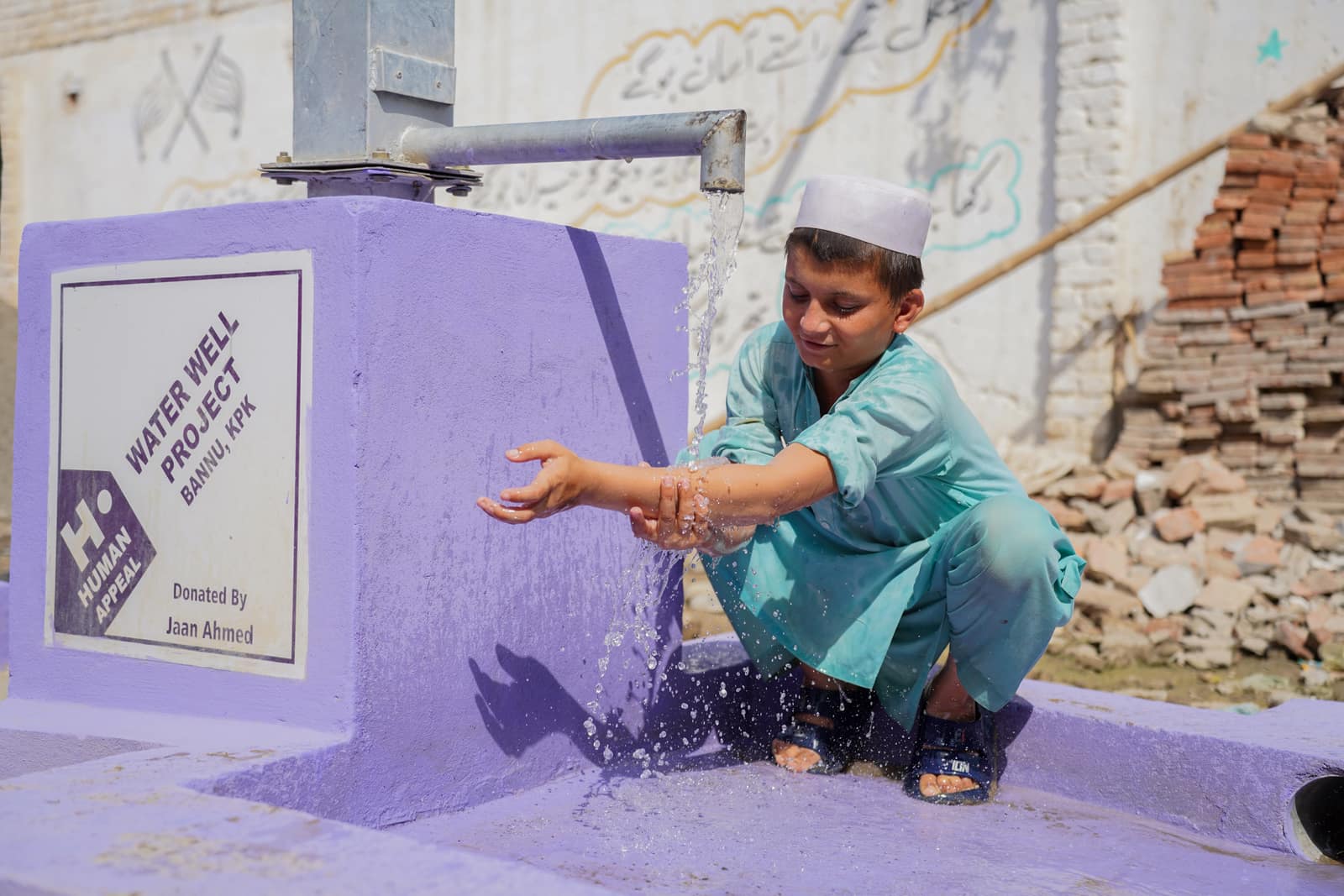
Human Appeal reports that a water well costs £880 and brings clean water to around 105 people in Pakistan and Bangladesh. It is worth sitting with that ratio for a second: a sum many people would spend on a weekend, turned into clean water for a hundred people, for years.
But the number is not the interesting part. The interesting part is what happens after the cheque clears.
The charity says its local teams build and install the well, sourcing materials locally where they can — which means the money does a second job, strengthening the economy of the community it serves. They fit a plaque in the donor's name, or a loved one's. And then, instead of leaving, they train a local committee to maintain the well and set up a small community fund for future repairs.
That last step is the one most people never hear about, and it is the one that matters most. A well that no one maintains is a well that breaks. A well with a trained committee behind it keeps giving water for years, and decades. When the work is done, the charity says it sends the donor a full report — including the exact GPS location of the well and photographs from the ground.
04
Sadaqah Jariyah: the gift that keeps giving
There is a phrase Human Appeal uses for this kind of work: Sadaqah Jariyah. It is an Islamic concept, and you do not have to share the faith to be moved by it.
Most charity is a single act. You give; a need is met; the moment passes. Sadaqah Jariyah is the rarer kind — charity that outlives the moment of giving, and often the giver. A well is its clearest expression. Every glass drawn from it, every crop it waters, every hour it hands back to a mother, continues long after the donation, and long after the donor.
It is a generous way to think about generosity. It asks not "what can I give today" but "what can I give that will still be giving when I am not here to give it." A well answers that question in the most literal way imaginable.
05
The scale of it, plainly stated
Human Appeal reports having built 3,368 wells across Pakistan, Somalia and Bangladesh, and says that 353,692 people gained access to clean water through its wells in 2025. In its 2024 annual report, its water work appears country by country — boreholes and trucked water in Somalia, hand pumps and wells installed across its country programmes, solar-powered wells in Togo serving thousands.
We have attributed each of these figures to Human Appeal deliberately. They are the charity's own counts, and we would rather you know that than have us present them as some independent audit. What is not in doubt is the nature of the work: tangible, repeatable, and built to last.
A well is not a headline. It does not photograph like an emergency. But it is, quietly, one of the most efficient pieces of good a person can do with a fixed sum of money — and it keeps doing that good long after everyone has moved on.
How to support this work
06
If this is the work that moves you, give directly to Human Appeal's Water Well Appeal. Your donation goes to the charity, not through us, and you can dedicate a well in your own name or a loved one's.
And if you would like to build an evening around this kind of cause — a fundraising event with a cricket legend at its heart — that is what we do. Plan a fundraising partnership with Sports Legends Media.
Reader Questions
FAQ
How much does a Human Appeal water well cost?+
Human Appeal reports that a water well costs £880 and brings clean water to around 105 people in Pakistan and Bangladesh. The charity fits a named plaque and sends a completion report with the well's GPS location.
What is Sadaqah Jariyah?+
Sadaqah Jariyah is an Islamic concept meaning an ongoing charity — a gift that keeps giving long after the giver has stopped thinking about it. A water well is a classic example, because it continues to provide for a community for years.
How does Human Appeal make sure the wells keep working?+
According to Human Appeal, its teams train a local committee to maintain each well and establish a small community fund for future repairs, so the well keeps providing water for years and decades rather than falling into disrepair.
How many wells has Human Appeal built?+
Human Appeal reports having built 3,368 wells across Pakistan, Somalia and Bangladesh, and says 353,692 people gained access to clean water through its wells in 2025.
Source Notes
More from this series
Syria
Al Imaan Hospital: One Building That Refuses to Close
Human Appeal's Al Imaan Hospital in Idlib, Syria treats around 6,000 people a month and is the only hospital of its kind in the area. The story of one building that keeps its doors open.
Orphans
Orphan Sponsorship: One Child, Kept
How Human Appeal's orphan sponsorship works — £40 a month, a child kept in school, and 35,607 orphans sponsored across 14 countries in 2024. A look at the charity's most personal work.